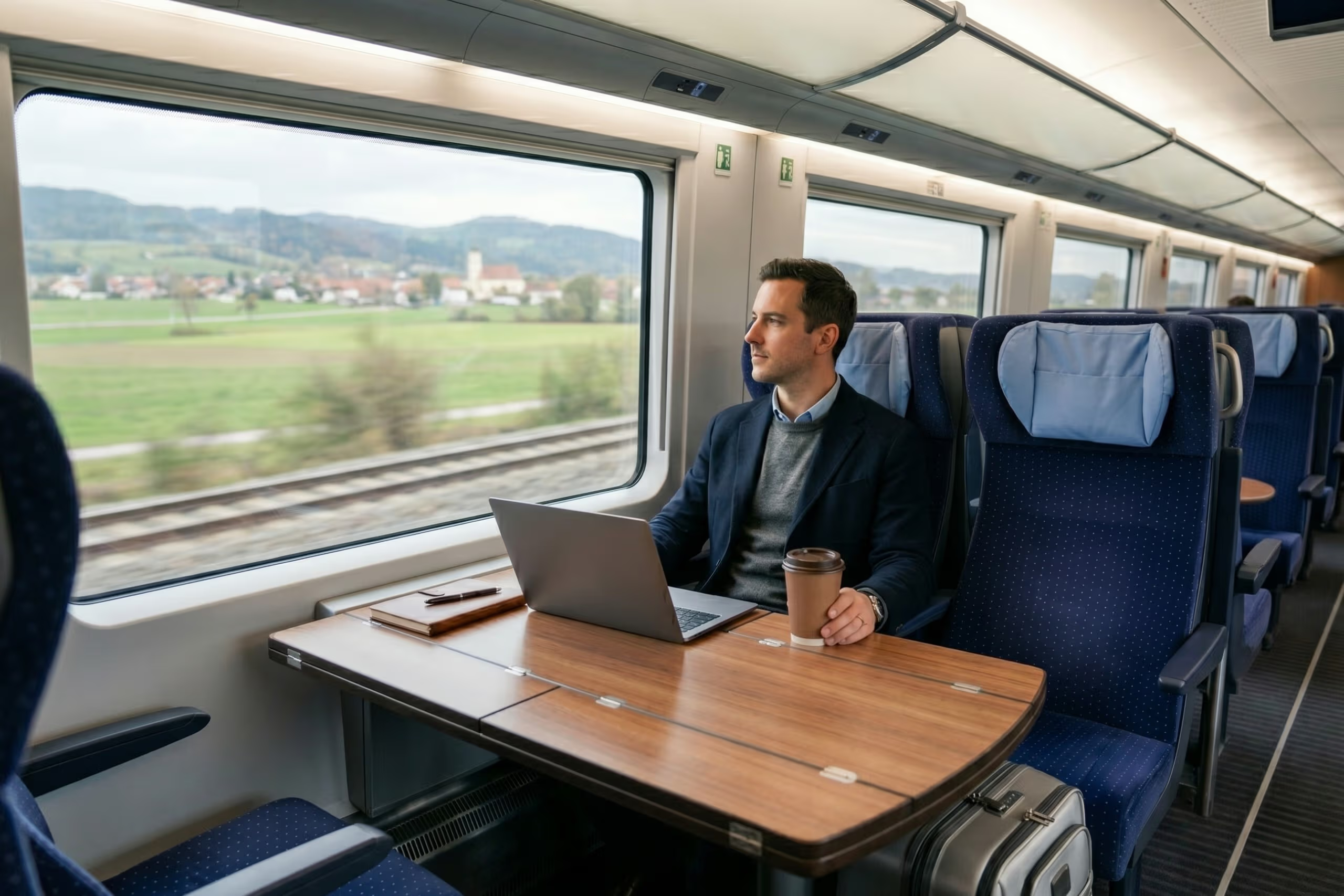
Building a travel program in 2026 means juggling far more than budget. Anyone managing or evolving one today needs to meet a whole range of criteria simultaneously: bringing employees on board, delivering reliable data, and reporting emissions transparently. And ideally, do all of this on a single platform.
Three experts discussed where corporate travel stands today and where it's headed: Stefan Büttner (Fleet Excellence Lead, Flix), Enrico Hahn (Strategic Alliances & Partnerships, Lanes & Planes), and Dan Kreibich (Co-Founder, SQUAKE). Here are the key takeaways.
Ten years ago, travel management was almost entirely about saving money and finding the cheapest possible connection from A to B. A lot has happened since then — above all, COVID-19, geopolitical crises, and rising prices — fundamentally reshaping the corporate travel landscape.
Today, we look at business travel differently. Every trip is a deliberate choice; in-person meetings are increasingly seen as an investment in relationships and trust, not just a box to tick.
At the same time, traveler expectations have risen. Employees now compare their booking tool directly to consumer platforms — if it takes 20 clicks, you've lost them. And in a hybrid work environment, the business trip is often the only physical touchpoint with company culture. That raises the bar for comfort, flexibility, and seamless processes considerably.
Why do employees book outside the travel program? Usually not out of defiance, but simply because the official tool isn't good enough. Four factors make the difference:
The interface needs to be fast, intuitive, and mobile. Anyone who books personal trips in a few clicks won't accept clunky legacy systems at work.
If travellers find more options or better prices elsewhere, they'll book outside the system. Comprehensive, competitive content — including alternative modes of transport like bus and rail — is not a nice-to-have, but a must.
There needs to be a clearly designated person or team responsible for the travel program. Travel management often sits between HR, Finance, and Procurement. Without clear accountability, there's no one driving improvements.
A tool must not be perceived as a control mechanism. The focus should be on the benefits for employees — centralised billing, no out-of-pocket expenses, automated expense processes. That's how you get everyone on board.
The webinar made one thing clear: corporate interest in bus and rail as alternatives to car or plane is greater than many travel managers would expect. At the same time, honesty is required about where these options realistically fit into corporate travel strategies today (and where they don't yet).
For certain routes or companies without direct high-speed rail access, long-distance bus connections are a relevant option. What is often underestimated: the bus is a very low-emission mode of transport. Compared to domestic flights or the car, emissions are significantly lower. They are in a similar range to those of train travel.
What matters most is that these alternatives are visible in the travel program at all. Because only travellers who see bus and rail options in the booking interface will consider them.
A travel program without a solid data foundation is like a car without a dashboard: you're moving forward somehow, but you have no idea how fast or how much fuel is left.
Why does corporate travel need reliable data?
The good news: technology can be a huge help. What used to take hours in spreadsheets can today be automated, granular, and real-time with the right software.
Sustainability isn't going away – quite the opposite in fact. While some environmental regulations have been loosened recently, twice as many have been tightened. Clear emissions reporting is now an obligation for many companies, rather than just a nice-to-have.
In practical terms, that means carbon data needs to be reliable, granular, and methodologically sound. Granular doesn't mean "employee X emitted Y kilograms of CO₂" — it means data broken down by segment: flight, rail, hotel, car rental.
A useful framework distinguishes three phases:
Companies that work through these phases systematically will be ready for reporting. And in many cases, they will also save money in the process.
The discussion ends with a clear vision: a system where specialised tools communicate seamlessly with one another — from the booking interface through expense management to emissions reporting. A system without media breaks, without heavy manual effort, and without unwieldy spreadsheets.
In 2026, getting from A to B cheaply is table stakes. It's about managing travel strategically — data-driven, sustainable, and with a user experience that employees actually adopt.
This article is based on the webinar "Moderne Reiseprogramme gestalten: Adoption, Datenqualität & Emissionstransparenz im Business Travel" with Lanes & Planes, Flix, and SQUAKE, held on March 25, 2026. Watch the full webinar here.
Subscribe to our newsletter
Achieve your climate targets. Get helpful tips and industry updates.
Stay connected with us
Follow us on our social media networks