Sustainable Aviation Fuel comes up in almost every conversation about decarbonizing corporate travel, yet most travel and sustainability teams still aren't sure how to act on it. Is it a pricing problem, a supply problem, or simply a lack of guidance on where to start?
To get a clearer read on where things actually stand, we asked two experts who work closely with organisations on SAF adoption and corporate travel sustainability, three questions:
- When do you think SAF will actually be mainstream for corporate travel?
- What's the biggest barrier to SAF right now: price, supply, or awareness?
- What do you tell a company that wants to act on SAF but doesn't know where to start?
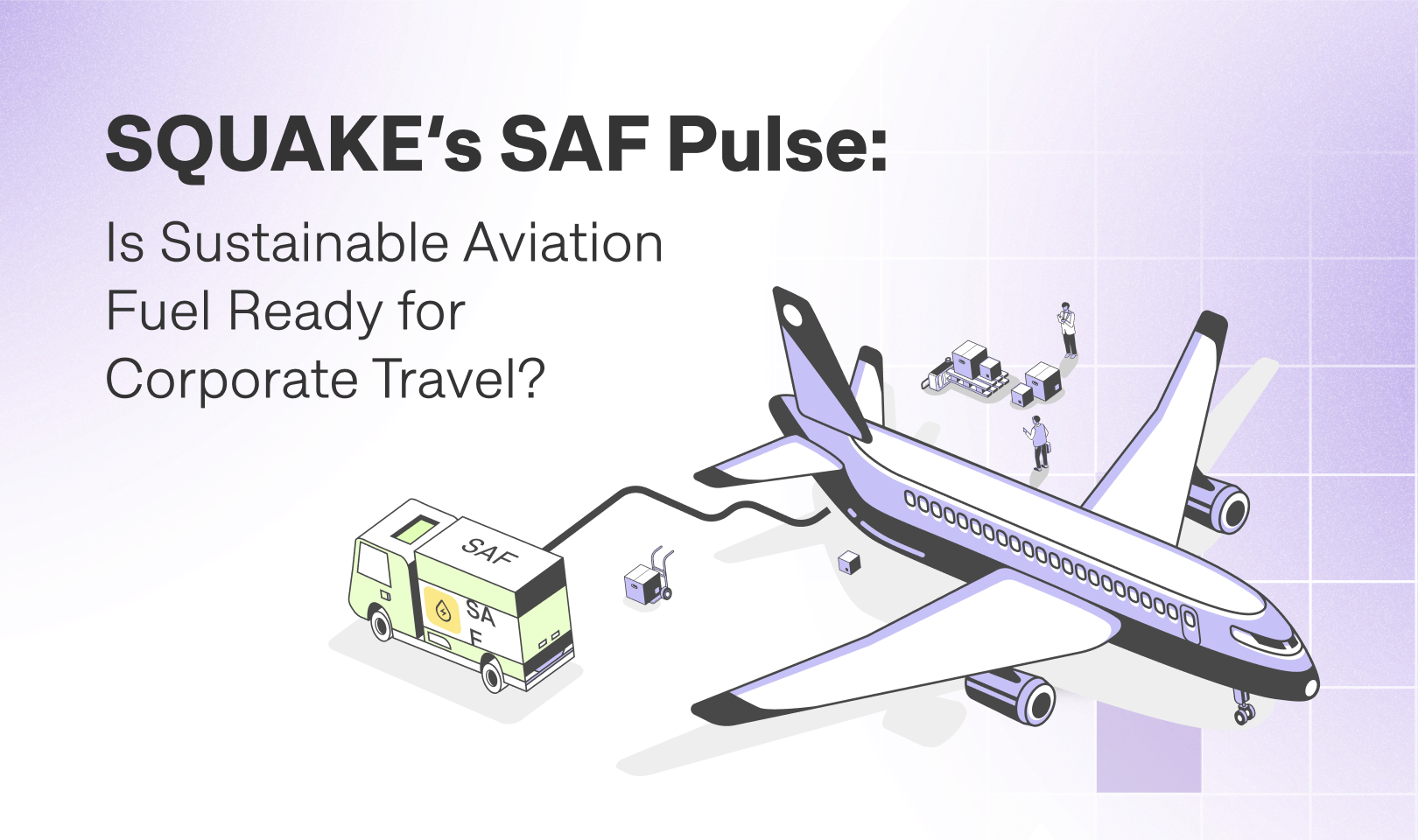
Here is SQUAKE's SAF Pulse.
Who we spoke to
1. Price and budget are still the biggest barrier
Both experts pointed to the same root issue: it's not that companies don't want SAF, it's that both pricing and budgeting for it is genuinely hard.
David Lourens, SQUAKE, sees this play out in the data:
"From a recent survey conducted by British Airways, where corporates ranked their main considerations when purchasing sustainable aviation fuel certificates (SAFc*), financial considerations such as price and budgeting were found at the top of the list.
Price discrepancies across producers, suppliers, and brokers leave companies unsure what a fair SAFc price actually is. With little or no centralized ESG budget for SAF procurement, organizations struggle to determine what they can afford and where the funding should come from before committing to a purchase."
Fabio Fornari, BCD, agrees, but adds that the barrier runs on both sides of the market:
"There's a physical barrier in terms of supply, which is a blocker in many ways, but that's a natural part of scaling. Different incentives need to be in place to remove some of the barriers to scale SAF. You see a lot of mandates, but a mandate without the right incentives to scale the industry won't meet its targets. On the customer side, the barrier is usually understanding what SAF actually means and how to personalize it for their program. Price is still a component too. So there are basically two streams: the industry that needs to scale, and removing the barriers around knowledge and how SAF can be integrated into travel programs. At some point supply and demand will connect, but it will take time. Without scaling the industry, without more transparency, and without harmonized systems across different markets, that variance will remain."
2. Mainstream is still years away, and regulation is part of why
Neither expect SAF to become a default part of corporate travel programs quickly, and both point to standardization as the real unlock.
David Lourens ties the timeline directly to compliance clarity and technology:
"The industry currently has a lot of moving parts, particularly around the regulations and guidance on what's allowable under SAFc accounting, SBTi, and the GHG Protocol. Many organizations remain indecisive and slow to act until these compliance and claimability questions are clarified. As the industry standardizes and technology providers and regulators push for greater transparency, organizations are becoming better equipped to understand the value of procuring SAFc to address their flight emissions."
Fabio Fornari puts a rough number on it:
"That's going to take time, because the industry is still evolving in different ways. One is the actual supply, developing SAF at the scale needed to become mainstream will take time. On the other hand, for corporate customers, not just airlines, to include this in their strategy is something that takes time too: understanding how to embed it into a travel program in a way you can align different stakeholders on how you're going to use, report, and account for it. I'd say it's probably going to take around a decade to actually become mainstream, mainstream in the sense that every time you talk about SAF, people know what you're talking about, know how to use it, know its role and its impact. We're starting the conversations and developing the solutions to get there, but probably by the mid-2030s we'll have SAF as a more integrated and credible part of sustainability in travel programs."
3. Fabio's advice: Start small, and start now
For companies that want to act but don't know where to begin, Fabio Fornari's advice was direct: don't wait for the market to mature before you start figuring it out.
"It's common not to know where to start. The first thing I'd say is talk to people who have expertise in this area. We work together to figure out where you can start. Don’t try to cover everything at once: start small, understand the market, maybe start with a pilot, and align internally with the right stakeholders. Price is a component that can scare people off, thinking it's too costly, but that's not necessarily the case. The sooner you start, the sooner you work through the many questions that arise during internal alignment. We had a recent discussion where the question was, should I wait for the market to mature before I start? I'd say no, because those questions, how do I integrate this into the travel program, how do I report on it, what certificates do I get, how do registries work, will still be there even once the market matures. Even if it feels a bit scary, the sooner you start, the better."
Closing perspective: Standardization is the common thread
Price, supply, and timeline all sound like separate problems, but both David and Fabio kept circling back to the same fix: standardization and transparency. Once pricing, compliance, and reporting are consistent across suppliers and markets, the hesitation both experts describe starts to disappear, and the internal case for budget gets a lot easier to make.
It's also worth being clear about what SAF is and isn't. It works best as one lever within a broader travel sustainability strategy, alongside emission calculations, policy, and reporting across the rest of the travel program, rather than as a standalone initiative on its own.
Strategic takeaways
1. Price uncertainty, not lack of interest, is the main blocker.
Corporates want to buy SAF, but inconsistent pricing across suppliers makes it hard to know what to budget, and there's rarely a dedicated line item for it yet.
2. Transparency unlocks more confident procurement.
Clear guidance on how to procure SAFc and its claimability in SAFc accounting, allows organizations to transition from indecisive to invested.
3. Waiting for the market to mature doesn't remove the internal work.
Integrating SAF into a travel program, reporting on it, and aligning stakeholders are questions every company will face regardless of timing, so starting early pays off.
From industry insight to action
For travel and sustainability teams, the SAF conversation keeps stalling on the same two questions: what should this cost us, and how do we make the business case internally. That is exactly the gap between interest and action that both experts described.
As standards mature and market transparency increases, travel managers, sustainability leaders, TMCs like BCD, and technology providers all have a role to play in helping organizations adopt SAF credibly and confidently.
If you're looking for a concrete first step, BCD's SAF starter pack breaks down exactly how to begin evaluating and procuring SAF for your travel program. Download it here.
SQUAKE helps companies build the clarity needed to move forward, giving travel programs visibility into the emission calculations behind their travel decisions and a harmonized way to evaluate and act on options like SAF, rather than facing the pricing and reporting confusion alone.
Interested in discussing how sustainability is evolving across the travel ecosystem? Get in touch with Team SQUAKE.
*Most of what companies buy today isn’t fuel physically loaded onto their own flight, it’s a SAF certificate (sometimes called SAFc) through a book-and-claim system, representing SAF used elsewhere in the supply chain. For simplicity, we use SAF throughout this article to refer to that broader system.